What Is Agentic Engineering? The Complete Guide
Agentic engineering is the discipline of designing, building, and operating autonomous software agents that work within real-world systems. Not chatbots. Not prompt chains. Production software that observes its environment, makes decisions, takes action, and learns from results. All within defined boundaries.
The term gets thrown around loosely. This guide defines it precisely. We will cover what agents actually are, how agentic engineering differs from traditional development and the newer "vibe coding" trend, why human oversight is non-negotiable, and where this discipline creates real value.
StencilWash is an agentic engineering company. This is what we do every day. So consider this both a guide and a working definition from practitioners.
What Makes Engineering "Agentic"
Traditional software follows explicit instructions. You write code that says: when X happens, do Y. Every pathway is predetermined. This works well for predictable problems.
Agentic engineering introduces a different model. You build software that can perceive its environment, evaluate options, and choose actions based on context. The agent has goals, not just instructions. It adapts to variability rather than breaking when inputs fall outside a predefined set.
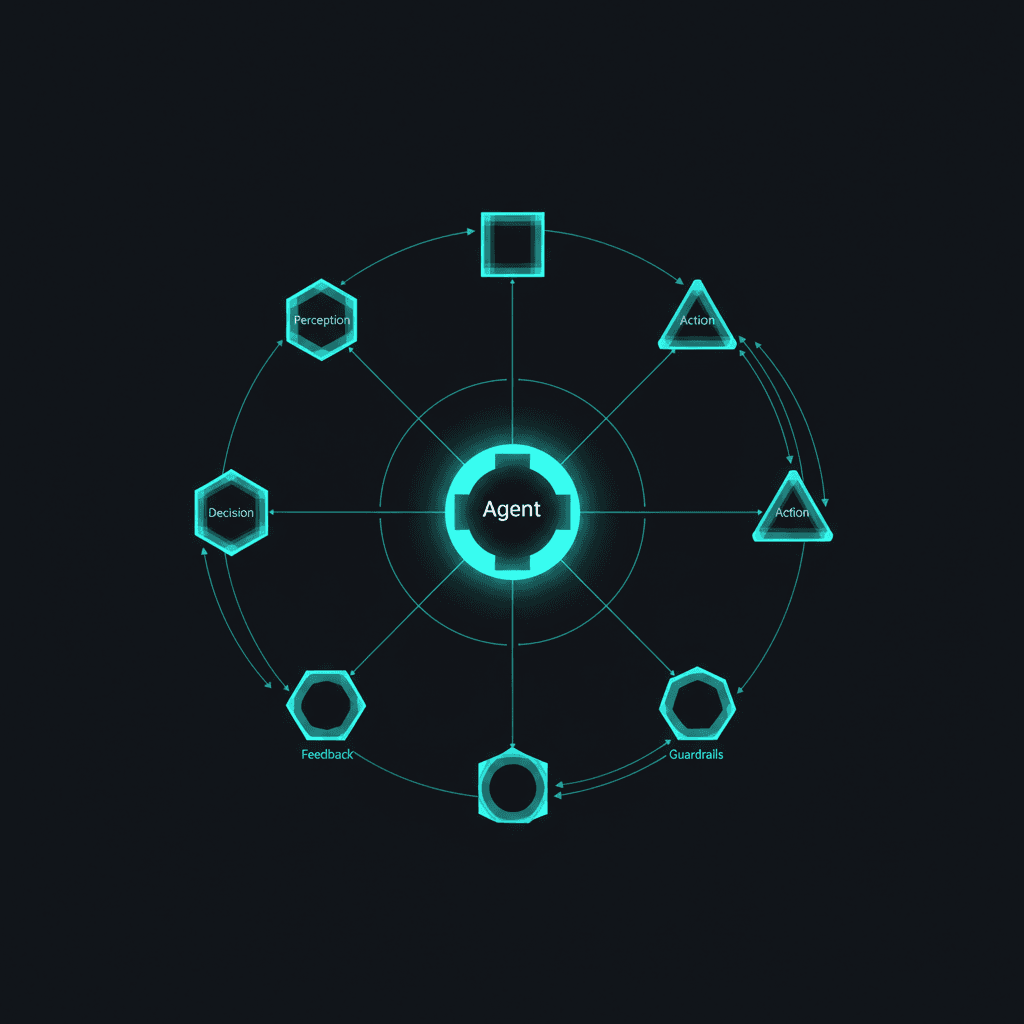
An agentic AI architecture typically includes these components:
- Perception layer: data ingestion, normalization, and context assembly
- Decision engine: logic evaluation, model inference, and action planning
- Action executor: operation execution with retry logic and error handling
- Feedback collector: outcome tracking and performance monitoring
- Guardrail system: rate limits, permission checks, and safety boundaries
- Audit logger: complete action history with decision traces
Each component serves a specific purpose. Remove any one of them and the system becomes either brittle or dangerous.
The key distinction: agentic systems handle variability by design. Traditional automation handles it by exception.
Agentic Engineering vs. Traditional Development vs. Vibe Coding
These three approaches occupy very different positions on the spectrum of software creation. Understanding the differences matters because choosing the wrong approach for your problem wastes time and money.
Traditional Software Development
You define requirements. You write code. The software does exactly what you told it to do. Every edge case needs a handler. Every decision path needs explicit logic.
Strengths: Predictable, testable, well-understood. Decades of tooling and best practices.
Limitations: Scales poorly with complexity. When a workflow has hundreds of decision points that shift based on context, the codebase becomes unwieldy. Adding a new condition means touching existing logic.
Vibe Coding
A newer approach where developers describe what they want in natural language and let AI generate the code. Fast for prototypes. Useful for simple applications.
Strengths: Speed. You can build a working demo in hours.
Limitations: The developer often does not fully understand the generated code. Error handling is inconsistent. Security considerations get skipped. It works until it does not, and debugging code you did not write is harder than debugging code you did.
Vibe coding produces software. Agentic engineering produces systems. The difference is significant.
Agentic Engineering
You design agents with defined goals, constraints, and oversight mechanisms. The agents make decisions within boundaries you set. They handle variability, adapt to changing conditions, and coordinate with other agents or humans as needed.
Strengths: Handles complexity and variability. Operates continuously. Improves over time through feedback loops.
Limitations: Higher upfront design cost. Requires careful guardrail design. Not appropriate for simple, deterministic problems.
The comparison is not about which is better. It is about which fits the problem. Simple CRUD application? Traditional development. Quick prototype? Vibe coding might work. Complex operations with variable inputs and continuous decision-making? That is where agentic engineering earns its place.
How Autonomous Agents Work in Production
A demo agent and a production agent share almost nothing in common. Demos handle the happy path. Production agents handle everything else.
In production, an AI agent framework needs to account for:
Failure modes. APIs go down. Data arrives malformed. Models hallucinate. Every agent needs graceful degradation. The ability to fall back to a safe state rather than propagating errors through the system.
Cost control. Agents that call LLMs or external APIs accumulate costs. Without rate limiting and budget constraints, a runaway agent can generate thousands of dollars in API charges in minutes. We have seen this happen.
Observability. You need to know what every agent is doing, why it made each decision, and what the outcome was. Black-box agents are unacceptable in production. Every action gets logged. Every decision gets traced.
Coordination. Real systems involve multiple agents working together. A content agent generates posts. A scheduling agent determines when to publish them. An analytics agent measures performance and feeds insights back. These agents need to share context without creating tight coupling.
This coordination pattern. Specialized agents with defined scopes communicating through shared context. Is what separates agentic engineering from "just using AI." The architecture matters as much as the intelligence.
Why Human-in-the-Loop AI Systems Are Not Optional
There is a temptation to remove humans from the loop entirely. Full autonomy sounds efficient. In practice, it is reckless for most applications.
Human-in-the-loop AI systems keep humans involved at critical decision points while letting agents handle routine operations. The ratio varies by use case. Some systems are 95% autonomous with human review on exceptions. Others require human approval for every significant action.
Here is why this matters:
Trust is earned incrementally. A new agent should start with tight human oversight. As it proves reliable, you expand its autonomy. This is not a philosophical position. It is practical risk management.
Some decisions require judgment. An agent can draft a response to a negative customer review. But the decision to publish that response. Especially when the customer is upset. Benefits from human judgment. Context, tone, and relationship history are difficult to fully encode.
Accountability requires traceability. When an agent acts on behalf of your organization, you are responsible for its actions. Human checkpoints create clear accountability boundaries.
Regulatory environments demand it. In healthcare, finance, and legal contexts, fully autonomous decision-making is often not permitted. Human-in-the-loop is not just good practice. It is a compliance requirement.
The goal is not to limit agents unnecessarily. It is to match the level of autonomy to the level of risk. Low-stakes, high-volume decisions can be fully automated. High-stakes, nuanced decisions need human involvement.
Agentic Engineering in Practice: A Real Example
We recently built an agentic marketing system for a nail salon in Lancaster County. The owner was a solo operator. One chair, no time for marketing, no budget for a traditional agency.
The system consists of five coordinated agents:
- Content agent: generates social media posts matched to the salon's voice and seasonal trends
- SEO agent: monitors local search rankings and optimizes the Google Business Profile
- Review agent: drafts responses to Google and Yelp reviews within minutes of posting
- Scheduling agent: builds weekly content calendars based on engagement data
- Analytics agent: tracks performance and feeds insights back to the other agents
The owner spends about two hours per week reviewing drafts and approving responses. The system handles the rest.
This is agentic engineering applied to a small business problem. Not a demo. Not a concept. A working system that runs every day.
The architecture is the same one we would use for an enterprise client. Specialized agents with defined scopes. Human-in-the-loop checkpoints. Feedback loops between agents. Audit logging. The scale differs. The engineering principles do not.
You can read the full case study in our post on building an AI marketing team for a nail salon.
When Agentic Engineering Is the Wrong Choice
Honesty about fit matters more than selling a service.
Agentic systems are not appropriate when:
- The problem is deterministic. If every input maps to a known output, traditional automation is simpler and cheaper.
- The task happens rarely. Agents are built for continuous or high-frequency operations. A task you run once a quarter does not justify the investment.
- Error costs are catastrophic and unrecoverable. If a single wrong action causes irreversible damage, the risk profile may not support autonomous operation. Even with human-in-the-loop.
- You cannot define success criteria. Agents need measurable goals. If you cannot articulate what good looks like, an agent cannot pursue it.
- Simple rules suffice. Not every workflow needs intelligence. Sometimes an if-else chain is the right tool.
Build agents where they solve problems that other approaches cannot. Everywhere else, use simpler tools.
The Infrastructure Behind Agentic AI Architecture
Building agents is one part of the work. Running them reliably is another.
A production agentic AI architecture requires:
Event-driven communication. Agents respond to events rather than polling for changes. This keeps the system responsive and efficient.
State management. Agents need to track their own state and the state of tasks they are responsible for. This state must persist across restarts and failures.
Permission scoping. Each agent gets access only to the resources it needs. No implicit permissions. Principle of least privilege applied to software agents the same way it applies to human users.
Kill switches. The ability to shut down any agent, or all agents. Instantly. At the agent level, the workflow level, or system-wide. This is not a nice-to-have. It is a requirement.
Monitoring and alerting. Real-time visibility into agent behavior. Alerts when agents deviate from expected patterns. Dashboards that show decision distributions, action counts, and error rates.
These are not optional extras. They are the foundation that makes autonomous agents production-viable. Without them, you have a demo that runs well in controlled conditions and fails in the real world.
Key Takeaways
- Agentic engineering is the discipline of building autonomous software agents that operate within defined constraints in production environments
- It differs from traditional development (explicit instructions) and vibe coding (AI-generated code) in its ability to handle complexity and variability
- Production agents require failure handling, cost controls, observability, and coordination mechanisms
- Human-in-the-loop oversight is practical risk management, not a limitation
- The architecture matters as much as the intelligence. Guardrails, audit logging, and kill switches are requirements
- Agentic systems are not always the right choice. Honest evaluation of fit saves time and money
Conclusion
Agentic engineering is a specific discipline with specific requirements. It is not a buzzword. It is a way of building software that handles complexity, operates continuously, and adapts to changing conditions. All within boundaries you define and control.
If you are evaluating whether an agentic approach fits your problem, we are happy to talk it through. We will be honest about fit.

Builds agentic systems with precision, depth, and zero tolerance for failure.